


High-speed Railway Wheel-Rail Vertical and Lateral Force Coupling Loading Simulation Device
Contact Info
- Add:No. 24199, Panwang Road, Longshan Industrial Park, Zhangqiu, Zip: 250000
- Contact: 张德儒
- Tel:0531-85966136
- Email:2995253509@qq.com
Other Products


High-Speed Railway Wheel-Rail Vertical, Lateral, and Longitudinal Force Coupling Loading Simulation Device
High-Speed Train Wheel-Rail Coupling Dynamics AnalysisVehicle-Track Coupling Loading Device
SimulationSingle Pile Vertical Cyclic Loading Test Device for High-Speed Railway Load
I. Device Introduction
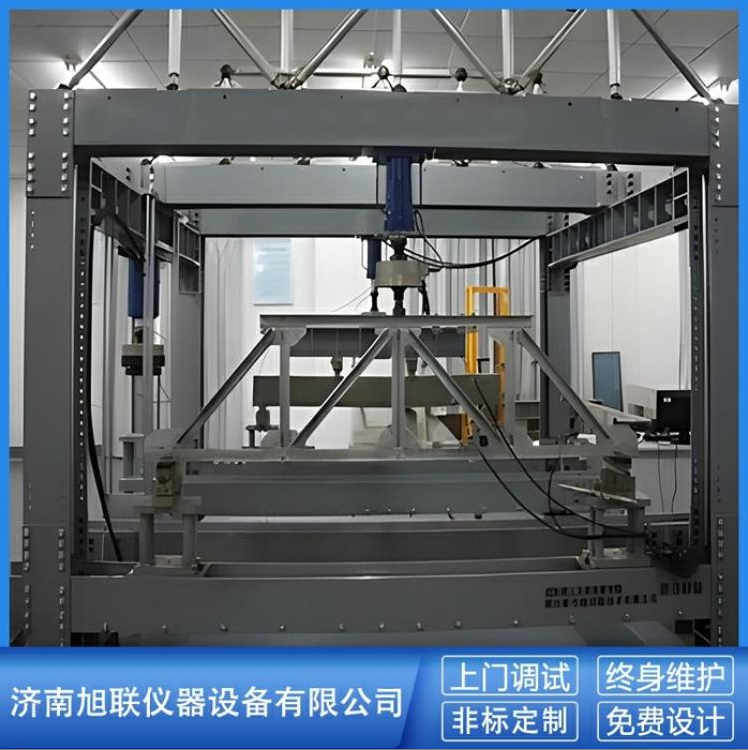
The wheel-rail vertical, lateral, and longitudinal force coupling loading simulation device includes a reaction frame and a high-speed railway track simulation structure located below the reaction frame. It can simultaneously simulate the vertical, lateral, and longitudinal forces acting on the track structure during actual train operation. The combination of lateral, vertical, and longitudinal forces simulates forces in other directions, making the test results more closely aligned with real-world conditions.
The bogie simulation mechanism mimics the high-speed train bogie. Vertical and lateral forces are transmitted to the bogie simulation mechanism, simulating the effects of vertical and lateral forces on the track structure during actual train operation.
Longitudinal forces are directly transmitted to the rail through a locking mechanism, simulating the effects of longitudinal forces on the track structure during actual train operation.
II. Equipment Composition
1. Loading Frame
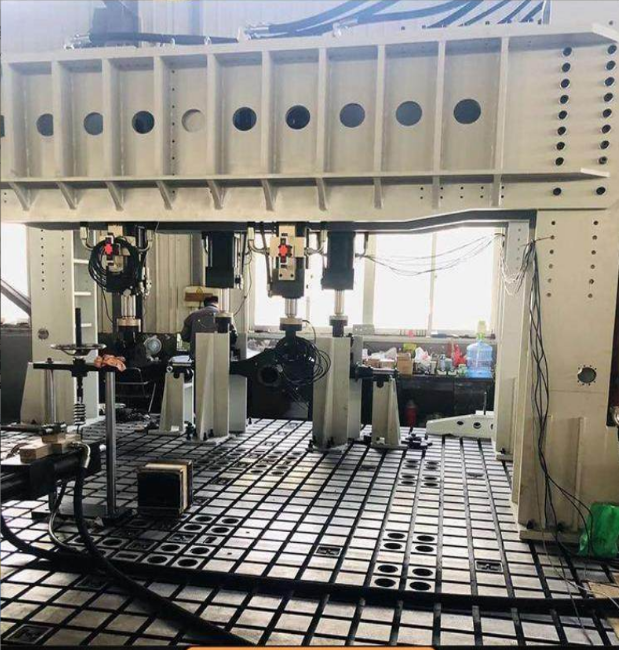
Utilizes a frame or gantry structure; the worktable features T-slots for easy installation of test pieces or fixtures; reaction supports are equipped with horizontally adjustable actuators.
2. Loading Module System
Vertical, Lateral, and Longitudinal Force Loading System:
Vertical Loading: Employs hydraulic servo actuators with a maximum loading force of 500 kN. High-precision pressure sensors monitor loads in real time, with control accuracy of ±0.5% FS, enabling precise vertical force loading and dynamic adjustment to simulate axle loads and unsprung mass effects on the wheel-rail.
Lateral Loading: Equipped with electric servo push rods, offering a maximum thrust of 200 kN and displacement resolution of 0.01 mm. This allows precise control of lateral forces, simulating wheel-rail lateral interactions during scenarios such as centrifugal force and lateral vibrations when trains traverse curves.
Longitudinal Loading: Utilizes an electro-hydraulic servo system with a maximum traction/braking force of 300 kN. The loading rate is adjustable from 0 to 10 kN/s, simulating longitudinal force variations during train startup, braking, and traction, as well as special conditions like wheel slip and skid.
Hydraulic Power Unit:
Total flow rate: 2000 L/min; system pressure: 21 MPa; total system power: 100 kW; water cooling system.
3. Data Monitoring and Acquisition System:
Force Sensors: Multi-axis force sensors installed at the wheel-rail contact points synchronously measure vertical, lateral, and longitudinal forces with a measurement accuracy of ±1%. Strain gauges are attached to key areas of the rail and sleeper to monitor structural stress changes.
Displacement and Speed Monitoring: Displacement sensors measure the relative displacement between the wheel and rail with an accuracy of 0.01 mm. Encoders and tachogenerators provide real-time wheel speed and operational velocity.
Data Acquisition and Processing: High-speed data acquisition cards with a sampling frequency of ≥10 kHz transmit sensor data to an industrial computer. Professional data processing software enables real-time display, storage, and analysis, generating force-time and displacement-time curves, and automatically producing test reports.
4. Servo Control System, Multi-Channel Coordinated Loading Software
Hardware Composition: Centered on a PLC controller, integrated with servo drives, frequency converters, touchscreens, and other devices to achieve precise control and coordinated operation of the loading and motion simulation systems.
Software Design: PC-based control software allows operators to set test parameters (e.g., train speed, axle load, track irregularity type) via a touchscreen. The software automatically controls system operations based on preset parameters and provides real-time feedback on device status and test data.
III. Technical Specifications
Vertical Loading Force Range: 0-500 kN, Control Accuracy ±0.5% FS
Lateral Loading Force Range: 0-200 kN, Control Accuracy ±1% FS
Longitudinal Loading Force Range: 0-300 kN, Control Accuracy ±1% FS
Wheel Speed Range: 0-600 rpm (corresponding to train speed 0-350 km/h)
Track Irregularity Simulation Types: Vertical profile, alignment, cross-level, twist, etc.
Data Acquisition Frequency: ≥10 kHz
IV. Application Scenarios
Wheel-Rail System Design Optimization: By simulating the coupling effects of vertical, lateral, and longitudinal forces under various conditions, the rationality of design parameters such as wheel tread profiles and track structure can be evaluated. This optimizes wheel-rail matching, reduces wear and noise, and enhances train operational safety and comfort.
Material Development and Performance Evaluation: Tests the mechanical properties, wear resistance, and fatigue life of new wheel and rail materials under complex stress conditions, providing experimental basis for the development and application of new materials.
Track Maintenance and Defect Analysis: Simulates the impact of track irregularities, rail wear, and other defects on wheel-rail forces, studies the progression of defects, and offers technical support for track maintenance strategies and the development of inspection equipment.
| Industry Category | Instruments & Meters/Testing Machines/Other Testing Machines |
|---|---|
| Product Category | |
| Brand: | 旭联仪器 |
| Spec: | 定制 |
| Stock: | 10 |
| Manufacturer: | 济南旭联仪器设备有限公司 |
| Origin: | 113701 |


